Schonbrunn Palace is a former imperial summer residence of the Habsburg Monarchs in Vienna. It was built in the baroque style in the 1740’s during the reign of Empress Maria Theresa who was given the estate as a wedding gift, and has 1,441 rooms. The Palace is one of the most important historical, cultural and architectural monuments in the Country and is a major tourist attraction.
We arrived at the Palace by the Vienna Metro/U-Bahn train, and at the entrance decided on the Gold Pass as it gave us admission to all the parts we wanted to visit, including the Palace, Gloriette, gardens, Zoo and Carriage Museum. We had previously purchase a Vienna Card which gave us a discount, and the Gold Pass cost us 40 Euros.
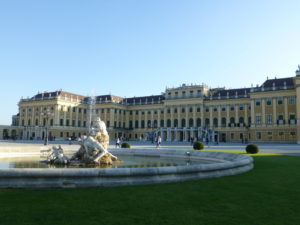
Front view of the Schonbrunn Palace.
We went straight into the Palace and were given an audio tour headset, which turned out to be wonderful.
Our ticket included the Grand Tour, which covers 40 rooms and lasts about 60 minutes. It included beautifully ornate State rooms, and the private apartments of Franze Joseph and Sisi. Unfortunately photographs weren’t allowed, but I highly recommend doing the tour if you can.
We exited the Palace and went around the side through the Privy garden and Pavilions, which were quite ornate and still had a surprising amount of colour considering it was early October.
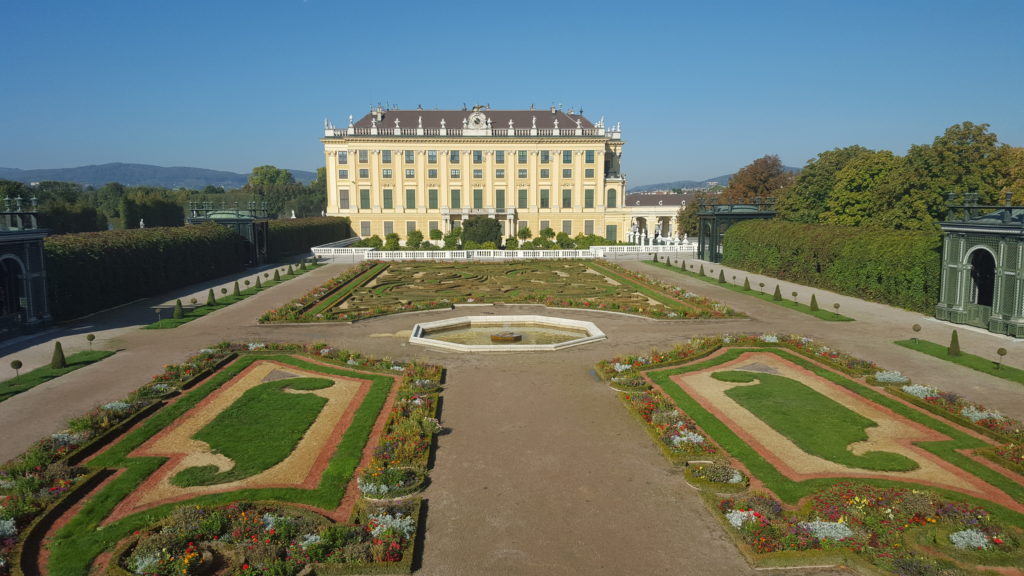
Privy Garden and side view of Palace.
The Orangery Garden was bigger than I thought, and the Orangery it’s self was interesting as it showed you how they used underfloor heating to warm the Hot House to protect the citrus trees in the winter. It is one of the largest Baroque Orangeries in the world, and nowadays much of it is used as a venue for functions.
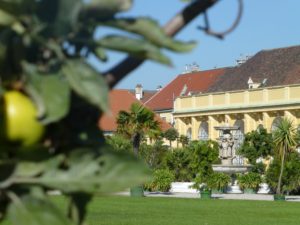
Orangery Garden.
From there we walked around to the back of the Palace to the Great Parterre, the sculpted garden between the Palace and the Sun Fountain.
This afforded a gorgeous view up the hill to the Gloriette at the top. The Gloriette was first built in 1775, was destroyed in WWII, but quickly restored by 1947. I had read that it was well worth the walk up the hill to see the views back from the Gloriette, so off we went passing by the Neptune Fountain on the way.
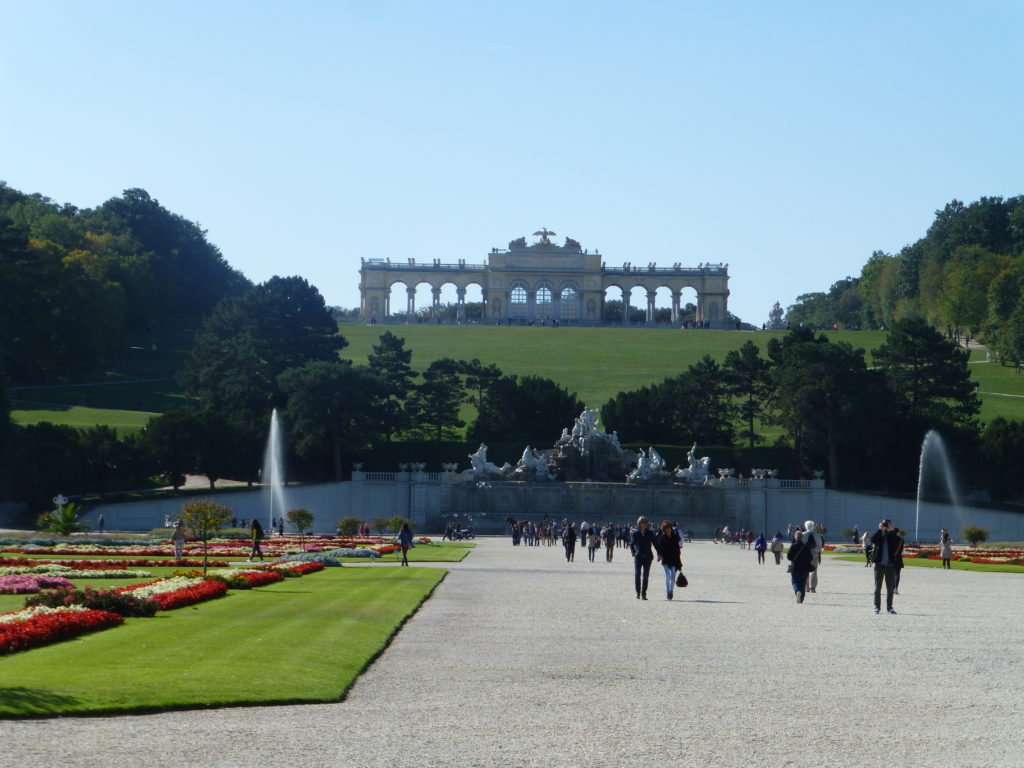
View up to the Gloriette.
By the time we climbed our way up to the Gloriette we were more than ready for some refreshment and thankfully the building houses a Café as well as a observation deck. It was fairly busy, but we managed to find a table outside in the sunshine and of course I had to order my favourite, Apple Strudel which arrived in a luscious lake of warm vanilla cream. My husband tucked into his ice cream sundae while we soaked up some sun.
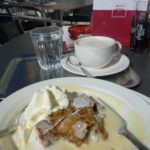
Apple Strudel.
When we were ready to move on we climbed up onto the observation deck on the roof of the Gloriette for a fabulous view down to the Palace, and the city of Vienna beyond. Really quite breathtaking especially on such a beautiful day! We then continued our exploration, and walked directly across the top of the hill and entered the Tiergarten (Vienna) Zoo from the top entrance.
The Zoo was originally founded as an imperial Menagerie in 1752 and it the oldest Zoo in the world. As we walked through it I was impressed with the animal enclosures and how naturally they were done. There was also a really nice selection of animals, including Elephants, Bears, Polar Bears, Lions, Cheetahs and even Pandas enjoying their Bamboo, which we got a great view off.
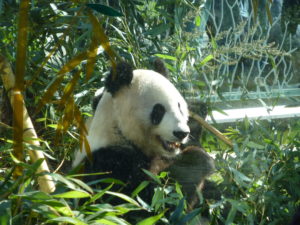
Panda at the Vienna Zoo.
We could have spent longer at the Zoo, but the day was getting on and we still had plenty to see, so we exited out from the bottom section of the Zoo back into the Palace garden area.
It was just a perfect day to be strolling through these elegant and formal gardens and I couldn’t help but think back to those times when the imperial Habsburgs would have wandered these avenues as they walked to the Palm House, our next stop.
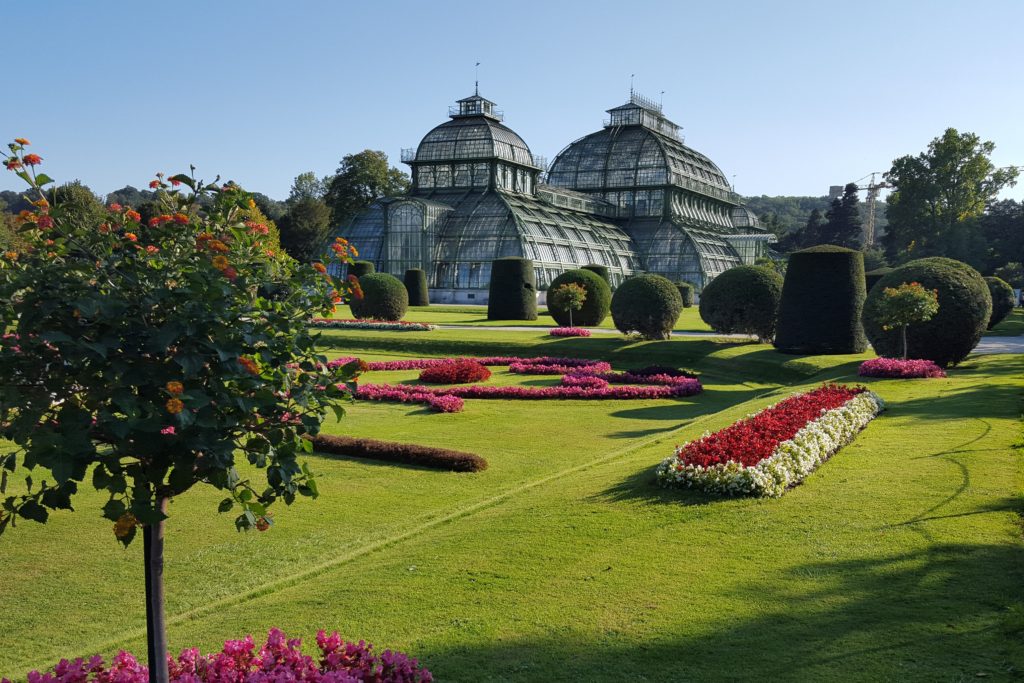
Palm House at Schonbrunn Gardens.
The Palm House was opened in 1882 and houses around 4,500 plant species, making it among the largest botanical exhibit of it’s kind. It was very humid inside, so after a quick look around we moved on the Desert House (Sundial House) next door. The Desert house is the newest of the botanical houses in the gardens and was built in 1904. The Desert botanical exhibit inside was opened in 2004.
Walking back through the gardens towards the Palace, our last stop of the day was the Imperial Carriage Museum. The building was the former winter riding school at the Palace, but was specially adapted in 1922 to be used at the Carriage Museum. It houses many imperial carriages, but the most important one is the Imperial Coach that was probably built for the Coronation of Joseph II in 1764. It would have been drawn by eight Greys, but with it’s weight of more than 4,000 kgs, it could only be pulled at a walking pace.
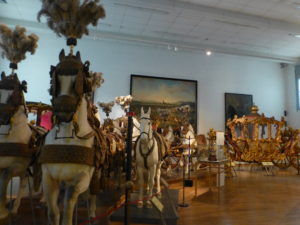
The Imperial Coach.
The museum also had a example of one of the dresses worn by Empress Elisabeth of Austria (Sisi) 1837 – 1898, I was amazed at the extremely tiny size of her waist! Apparently in later life she became obsessively concerned with her youthful figure and would demand to be sewn into her leather corsets.
It had been a long, but wonderful day exploring the many areas of Schonbrunn, but we were tired and it was getting late, so we brought our day to a happy and contented end.

View of Schonbrunn from the Gloriette.
Date of visit; 2nd Oct 2015.