The Spanish Riding School of Vienna is famous for it’s Lipizzaner horses and their demonstrations of the ‘haute ecole’ or ‘high school’ movements of the classical dressage. The Lipizzan breed dates back to the 16th century, when is was developed with the support of the Habsburg nobility. They are born dark coloured but usually turn grey by the time they turn 6 years old, however, in rare occasions they stay dark brown or black.
Since hearing about my Mother’s visit to the Spanish Riding School (SRS) when she was young, it had long been a dream of mine to visit, especially as I have ridden horses myself since I was a child. So when my husband had a business trip take him to Vienna, I just had to join him.
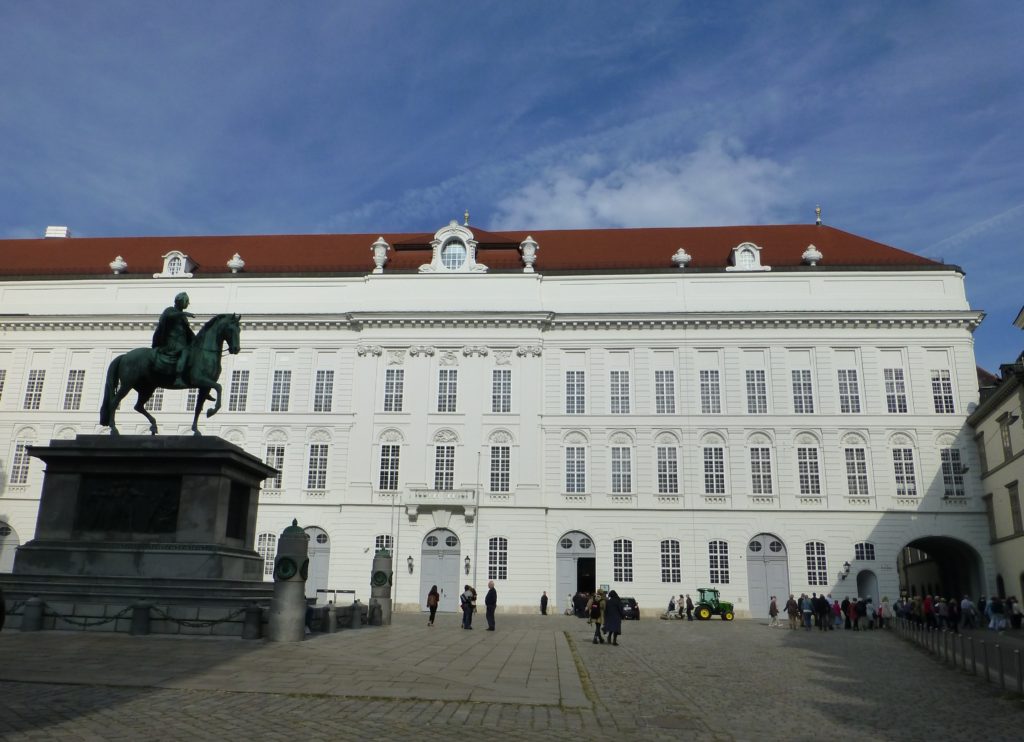
Winter Riding School, Vienna.
The Spanish Riding School is right in central Vienna, actually attached to the Hoffburg Palace, off Michaelerplatz. On my first day in Vienna I headed to the ticket office as I knew I wanted to get tickets for the Morning Exercise and the Guided Tour of the Riding School.
Morning Exercise.
Morning exercise is held on week days excluding Mondays and costs 15 Euros. Guided Tours are available most days in the afternoons, and cost 18 Euros. Performances are usually just on Saturdays and Sundays for most of the year, but all these change depending on the time of year so I suggest checking the website before you go.
My first day in Vienna happened to be a Monday, so at the ticket office I purchased tickets for the next day to do see the 10 am Morning Exercise, and then later in the afternoon to do the 2 pm Guided tour. I had already purchased tickets online for the Saturday performance as I wanted to make sure to get seats because it was our only chance to see it.
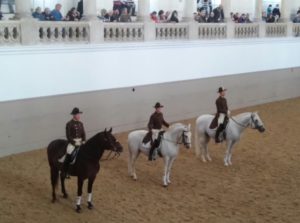
During Morning exercise.
So Tuesday morning I arrived back at the Ticket office with my ticket at just before 10 am and was ushered through into the lower balcony viewing area of the Winter Riding School. The Morning exercise runs for about 2 hours, from 10 until 12 noon. The exercise session is set to Viennese classical music and seemed to have a pattern of the riders putting the Stallions through their paces for about 30 minutes, with a warm up and warm down.
Then they would dismount in the arena, another Stallion would be brought out to them and the other walked out and back to the stables. So because of this, you are able to see a number of the horses , youngsters and older more experienced, and the different routines that the riders put them through. Photography isn’t actually allowed (mostly because of the flash and camera noise I think), but I snapped a few pics with my cell phone, making sure it was on silent and the flash was off – I just couldn’t resist, it was such a dream to be here!
As you can see in the above photos, there was actually a rare bay Stallion. This is because it is the tradition of the SRS to keep at least one bay Lipizzaner Stallion in their stables for good luck.
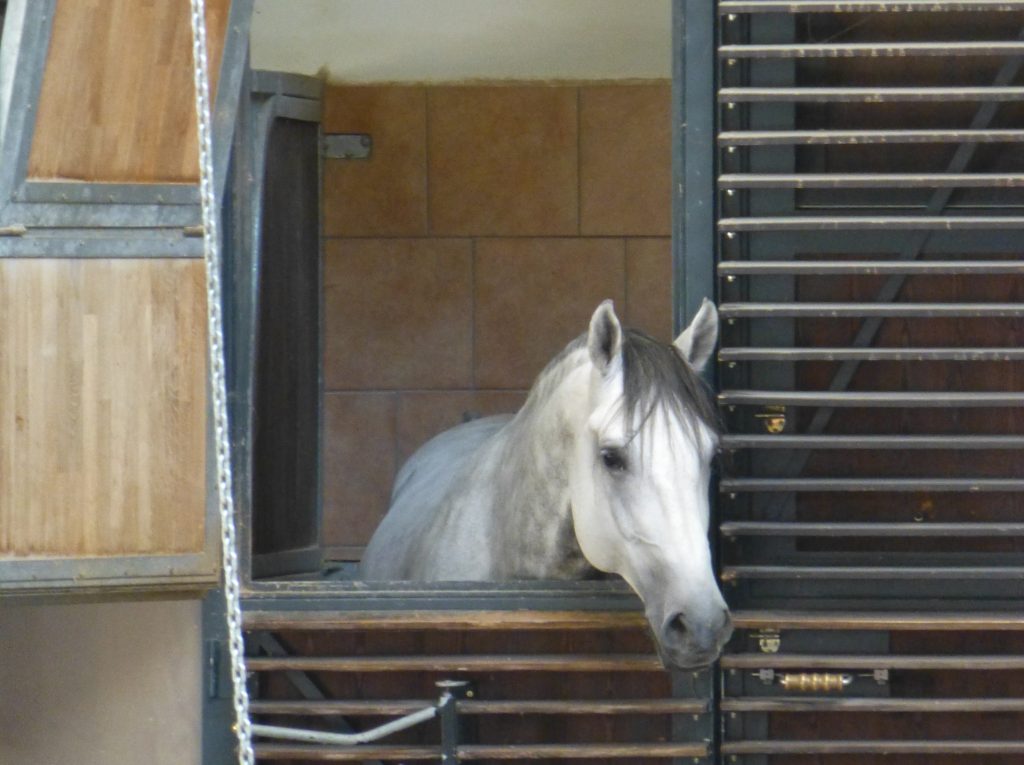
Lipizzaner in the Stables.
After getting some lunch I was back at the ticket office in time for my Guided tour at 2 pm. A lovely English speaking guide walked us over the road to the Stallburg, a Renaissance building that from the outside you would never guess that they house horses in! Most of the stables are completely inside, but a few do look out onto a courtyard area. Our guide walked us through the Stables giving us history on the horses and how they are looked after.
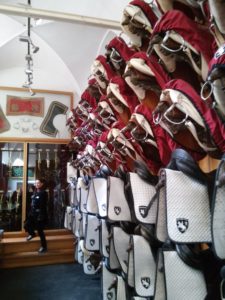
The Tack Room.
The Stables are very tidy as you would expect, and even quite ornate in areas, such as horse head busts on the walls and plaques with the horses name on each stable.
The Tack Room had everything in it’s place and the saddle racks had lovely ornate horse heads on the end of them. Here you could also see the subtle difference from the regular saddle to the special performance one.
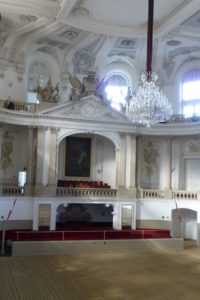
The Royal Box in the Winter Riding School.
Our guide then took us back across the road to the Winter Riding School, built in 1735, with it’s Baroque architecture, it really is quite impressive to walk into. We walked along the 1st Balcony level the full length of the arena, then down stairs and came out one of the corner entrances into the actual arena. We took a seat in the ground floor box, right below the Royal Box, and our guide talked to us about the training involved to become a Performance horse and fully trained rider.
Apparently riders start out as apprentices for 2 to 3 years, then move on to the next stage. It can take over 8 years for them to become fully trained, and for the last 6 years of that they are paired up with a Stallion and learn together so that they can become ready to take part in the performances.
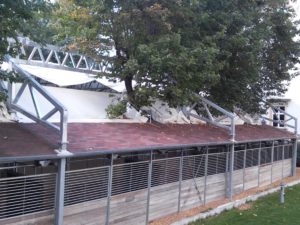
Horse Walker around the Summer Riding School.
After being allowed to take some photos, we were taken outside to the Summer Riding School area.
When I was there in late September, this was actually under a lightly tented area, and all around the outside is a huge horse walker. Usually horse walkers are a bit like a circular rotating washing line, where maybe 4 horses are attached to a line so that they can be exercised in a circle. This one however was on a completely different scale as it is actually the largest in the world and 10’s of horses can be exercised at once! The tour finished back at the ticket office where there was also a nice café and shop to explore.
On the Saturday morning I was able to fulfill my dream and we attended the 11 am performance of the Lipizzaner’s of the Spanish Riding School. Taking our seats in the Winter Riding School was so exciting, the lights were dimmed and the 3 huge chandeliers had been lowered down closer to the level of the lower balcony and glowed beautifully blue.
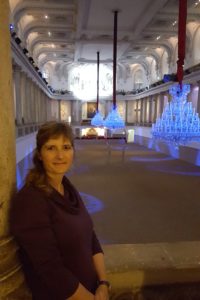
Excited, by my seat for the performance.
Our seats were on the lower balcony, at the end of the arena where the horses enter. You could look down the whole arena to the Royal Box and had a really good view. The lower balcony is still a good 20 feet above the ground, so when the horses are below you, you lose sight of them unless you lean forward and look down on them.
The chandeliers were raised up, the lights changed and it was performance time. There were a number of different performances, some by troups of 4 horses, some 2, and some individual. Between each there was commentary on what you were going to see next . Towards the end they moved on to the higher level moves known as the airs above the ground, movements where the horse leaves the ground. These include the Levade, Courbette and the Capriole which is considered the most difficult of the moves and requires an enormously powerful horse to perform correctly. To see these highly trained horses and riders performing like this was the perfect end to our stay in Vienna.
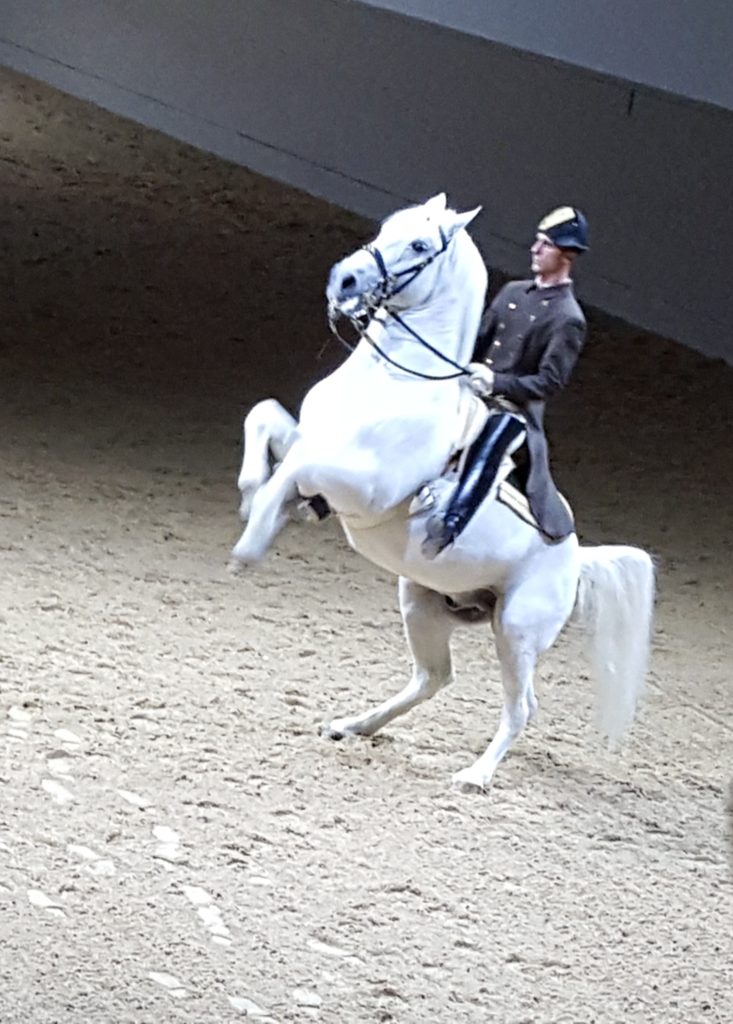
Performing the Levade.